 zishengelectric





news
News Center
Providing high-quality power to the world
Search productSearch post
news
Providing high-quality power to the world
Zisheng Electric’s guide to transformer design change control addresses a familiar EPC coordination problem: a revised drawing can be technically correct while the rest of the project still relies on the previous design. A terminal moves, a cable box grows or an accessory supply changes. Unless the affected teams receive and accept the change, manufacturing and construction can proceed toward incompatible interfaces.
The purpose of change control is to connect the proposed modification to a clear engineering decision. It should identify the approved baseline, explain the reason for change, assess connected equipment, assign approvals and define the evidence required before work resumes. The process should be proportionate. A spelling correction and a revised terminal arrangement do not need the same review, but both need traceable document identity.
Before reviewing a modification, record what has already been accepted. The baseline normally includes the purchase specification, technical clarifications, approved datasheet, outline drawing, terminal arrangement, accessory schedule and agreed inspection plan. Include the status and revision of each document. A file that was circulated for information should not silently become the manufacturing baseline.
Identify the stage reached by each affected package. The transformer may still be in design while the foundation has already been poured. Conversely, the transformer may be assembled while cable procurement remains open. The same dimensional change can have a very different consequence at these two stages. Record actual commitments instead of assuming that every discipline can revise its work at the same cost.
A supplier proposal describes a possible solution. Engineering approval accepts its technical basis, subject to any stated conditions. Implementation confirms that the accepted revision has reached the equipment, drawings and connected works. These are distinct events. Closing a change request as soon as a revised drawing is received leaves a gap between document acceptance and physical execution.

Classify changes using the interfaces they affect rather than the number of lines revised. A small note about an auxiliary supply can affect protection availability. A large drawing cleanup may have no functional consequence. The reviewer should ask whether ratings, insulation, thermal duty, fault performance, control behavior, dimensions, maintenance access or acceptance evidence are altered.
| Change example | Connected review | Required evidence | Release risk |
|---|---|---|---|
| Terminal position or cable box | Cable route, bend space and support loads | Coordinated outline and termination drawings | Cables cannot be installed without rework |
| Impedance or voltage ratio | Load flow, protection and fault duty | Updated study inputs and accepted guarantees | Equipment performance differs from the study |
| Cooling equipment | Auxiliary load, footprint and thermal basis | Revised equipment and control schedules | Cooling or electrical interfaces remain incomplete |
| Accessory contact or signal | Relay wiring, SCADA and cause-and-effect | Updated terminal plan and functional test | An alarm or trip reaches the wrong destination |
| Shipping arrangement | Transport envelope, lifting and assembly | Revised packing, weight and handling documents | Delivery equipment or site access is unsuitable |
| Test requirement | Acceptance criteria and witness planning | Agreed inspection plan and report scope | Shipment lacks promised acceptance evidence |
This table is a screening aid, not a substitute for the responsible discipline review. One change can occupy several rows. The change coordinator should identify the full review path before asking for approval, then track the responses against a common request identifier.
When a proposed change affects ratio, impedance, connection arrangement or rating, identify every calculation that used the previous value. The relevant team should decide which studies require revision and which remain valid with a documented explanation. A revised datasheet should not be accepted merely because its values look reasonable in isolation.
Keep nominal values, guaranteed limits and measured results distinct. A study may use an assumed impedance range while a quotation states a design target. The reviewer needs to compare the correct quantities on the same basis. Do not replace a conservative study assumption with a single measured value without understanding the purpose of the original range.
Operational configurations also matter. A change may be acceptable for normal supply and unsuitable for a contingency or temporary commissioning arrangement. Review the operating cases that the project has actually approved, including any planned parallel operation, generator supply or staged expansion. This article sets no universal acceptance limits; those belong in the project design basis and approved studies.
For dimensional revisions, compare terminal coordinates, foundation references, cable entry, removable covers and service access. Use a defined drawing origin and orientation. A dimension measured from the tank edge is not directly interchangeable with one measured from the foundation centerline. Confirm which reference is used by the civil and electrical installation teams.
A cable termination review should cover more than whether the cable reaches the terminal. Check installation approach, bending space, support arrangement and the loads transferred to the equipment. Responsibility for cable supports should be explicit. If a support is supplied by another contractor, include its interface drawing in the review rather than treating it as an unspecified site item.
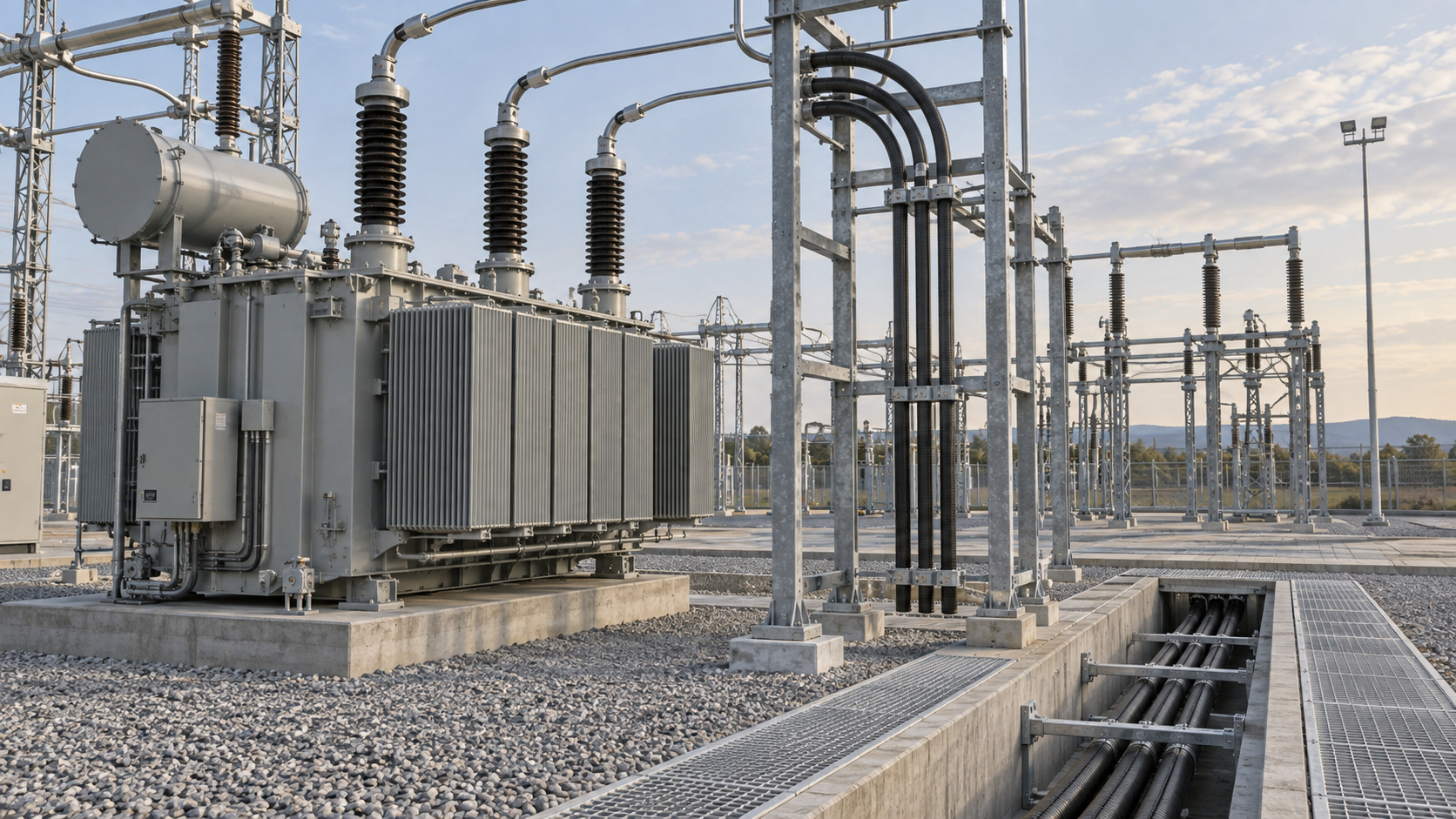
A final installed layout can fit while the assembly sequence remains impossible. Ask whether radiator installation, bushing erection, cable pulling or cover removal requires temporary access beyond the final footprint. The change review should consider this working space and identify any impact on nearby equipment, lifting arrangements and construction sequence.
Transport dimensions and assembled dimensions should remain separately identified. A revision that reduces the shipping envelope may increase site assembly work or change the required handling equipment. The document register should preserve both configurations so the logistics team and installation team do not work from different interpretations of the same drawing.
An accessory substitution is not equivalent merely because the replacement fits the mounting hole. Compare supply requirements, contact behavior, signal range, environmental suitability, connection details and the functions required by the specification. Identify any consequences for spare parts, commissioning instructions and maintenance documentation.
For signals connected to protection or plant control, coordinate the terminal plan, point list and cause-and-effect document. A change to contact logic must reach the test procedure as well as the drawing. The acceptance evidence should demonstrate the agreed behavior, including relevant abnormal conditions, using qualified personnel and approved test methods.
Record the exact offered component identity and the basis for acceptance. Broad descriptions such as equivalent switch or standard monitor are difficult to verify later. If the final model remains open, keep the change conditional and identify the hold point that prevents an unreviewed substitution from being installed.
Each change needs a coordinator, a technical decision owner and named reviewers for affected interfaces. These roles may belong to different organizations. The supplier can explain the transformer consequences, while the EPC designer confirms the connected system and the owner accepts operational implications under the contract.
Reviewers should return one of three clear responses: accepted, accepted with explicit conditions, or revise and resubmit. Silence should not be treated as technical acceptance unless the contract specifically establishes that process. Even then, safety-critical and functional interfaces require the responsible engineering decision to be documented.
Separate technical acceptance from commercial agreement. Engineering can establish that a proposed arrangement works while cost and schedule remain under negotiation. The release instruction should state whether work may proceed and under whose authority. Avoid allowing an unresolved commercial discussion to obscure the current technical configuration.
Design release requires a coordinated technical basis. Manufacturing release requires the affected drawings and instructions to be available to production. Inspection release requires the test scope and acceptance basis to match the actual configuration. Shipment release requires the delivered equipment and documentation to reflect the accepted revision.
At each gate, identify evidence rather than a generic signature. For a cable-box modification, evidence might include the accepted outline, interface review and dimensional inspection record. For a control change, it might include revised wiring, an updated signal schedule and functional verification. The project should decide the appropriate evidence before the work is declared complete.

This example is hypothetical and is not a Zisheng Electric customer project. An EPC team receives a proposal to move a transformer cable box after the foundation drawing has been issued. The change coordinator records the original and proposed revisions and asks the supplier to explain the reason, dimensional difference and effect on equipment guarantees.
The electrical designer checks the cable route and installation space. The civil designer checks the foundation and trench opening. The installation team checks the pulling sequence and support access. The procurement team checks whether cable lengths or supports have already been ordered. Each response identifies a concrete consequence rather than simply marking the proposal reviewed.
Suppose the review finds that the new arrangement is acceptable only if one support is relocated. The approval records that condition, assigns the support revision and prevents installation release until the coordinated drawings are issued. Receipt inspection then confirms that the delivered cable box matches the accepted arrangement. The request closes after implementation evidence is attached, not when the proposal is first accepted.
A useful register contains the request identifier, reason, affected equipment, baseline revision, proposed revision, discipline owners, decision date, conditions and closure evidence. Add the stage of manufacture or construction and any open actions. Link to controlled documents rather than embedding several untraceable copies in email chains.
After approval, withdraw superseded working copies through the project’s document-control process. Ask the responsible teams to acknowledge the new revision where required. If manufacturing or installation has already used an earlier revision, record the disposition of that work. Do not assume that issuing a new PDF automatically changes the equipment.
For a transformer design change control review, provide the original and proposed drawings, datasheets, technical specifications, single-line diagram, load list, grid parameters, environmental conditions and installation-site constraints. Identify the decision deadline, manufacturing stage and connected packages already released. Mark assumptions so the reviewer can distinguish confirmed information from an open interface.
Review the custom engineering options and EPC equipment supply interfaces with Zisheng Electric. Relevant equipment references include the oil-immersed substation transformer and power transformer. Confirm the actual offered configuration before approving changes to terminals, cooling accessories or control interfaces. Our engineering team will review the requirements and respond to project inquiries within 24 hours.

Factory-Direct Transformer Supply for Global EPC Projects For an EPC contractor, choosing a transformer supplier is rarely just about line items on a datasheet. The manufacturer standing behind the equipment has a direct bearing on how smoothly de...
View details
Reliable Transformer Supply for Renewable Energy, Industrial, Utility, and Infrastructure Projects For EPC contractors, the decision of which transformer manufacturer to work with can shape how the entire project unfolds. A transformer is just one...
View details
In EPC projects, transformer issues rarely appear during the quotation stage. They usually become visible later — during installation, inspection, or commissioning, when changes are costly and project schedules are already under pressure. A transf...
View details
Plan transformer noise control for EPC substations by coordinating equipment sound, layout, foundations, ventilation, factory verification and site acceptance across supplier and project interfaces.
View details