 zishengelectric



news
News Center
Providing high-quality power to the world
Search productSearch post
news
Providing high-quality power to the world
Cooling fans can increase a dry-type transformer’s usable capacity when the manufacturer approves a forced-air rating for that specific design and installation. Bolting fans onto an existing unit does not create a new rating. For a Zisheng Electric enquiry, begin with the transformer identification, present loading and proposed duty so engineering can assess whether a supported upgrade is available.
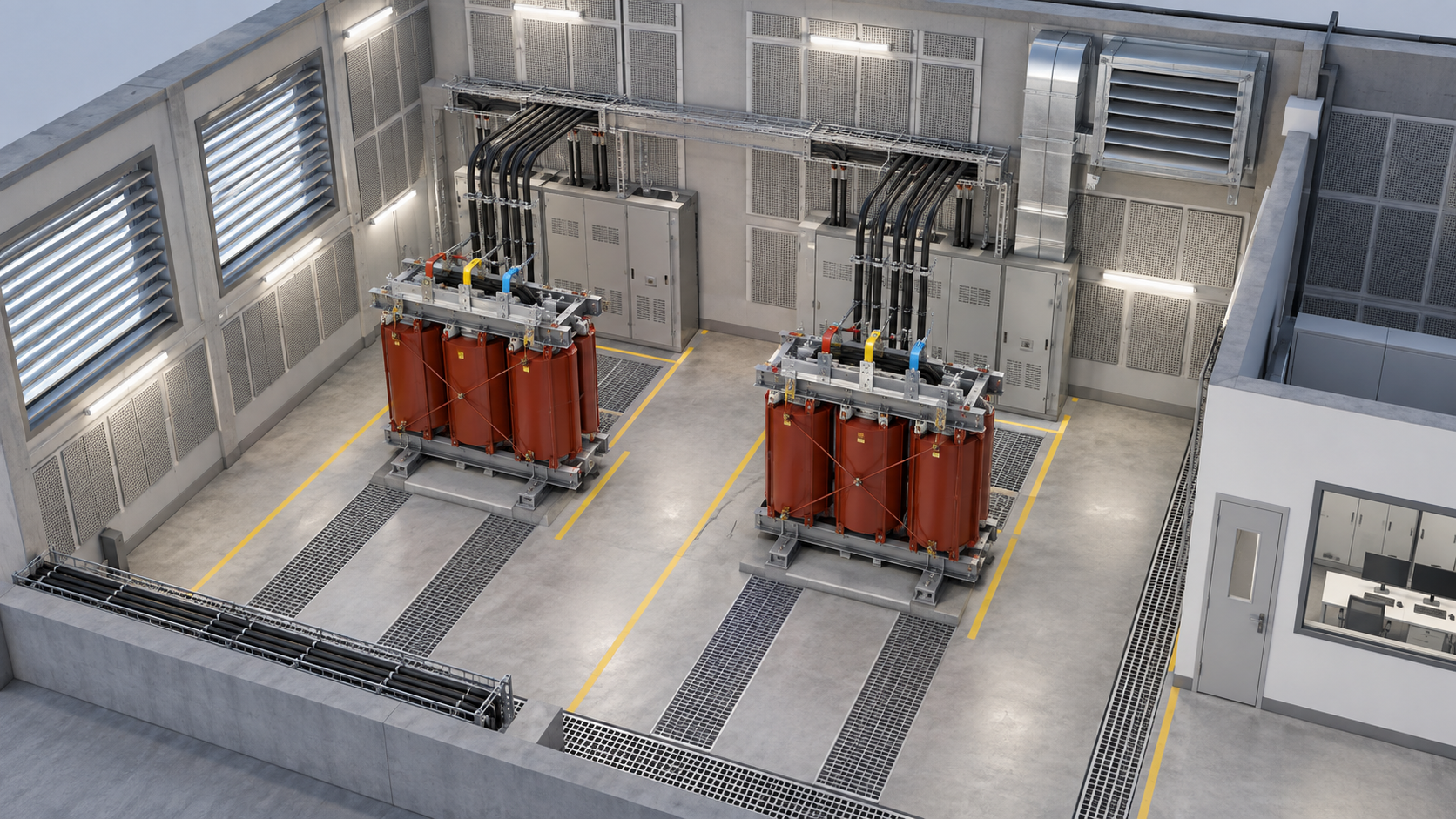
For an EPC electrical engineer, the purchasing decision extends beyond the fan kit. The transformer, enclosure, conductors, protection and room must support the intended operating condition together. A low-cost accessory can become an expensive project if these interfaces are reviewed after the order.
Natural-air cooling relies on air moving without fans. Forced-air cooling uses fans to assist heat removal. Depending on the documentation convention, these modes may appear as AN/AF or AA/FA. Ask the supplier to define the notation used on the offered rating schedule.
Some transformer designs have provisions for a future fan kit. That provision is not evidence that any available fan, airflow direction or control arrangement will produce an acceptable uprating. Obtain written confirmation of the compatible kit, resulting kVA rating, ambient conditions, temperature-rise basis and permitted duration of operation.
Schneider Electric’s UK guidance for its Trihal range describes a possible temporary 40% increase under the specified product conditions. This is a product-specific example, not a rule for all dry-type transformers. Do not transfer that percentage to another model or describe a temporary allowance as an unrestricted continuous rating.
For a balanced three-phase system, line current is I = S / (√3 × V), using apparent power in VA and line-to-line voltage in volts. This gives a useful starting point for the electrical interface review. It does not establish cable ampacity, protection settings or transformer suitability.
Consider a hypothetical 1,000 kVA, 400 V transformer whose manufacturer has approved a 1,400 kVA forced-air duty under stated conditions. The corresponding currents are approximately 1,443 A and 2,021 A. The additional current of approximately 577 A must be considered at the terminals, busbars, cables and switching equipment. These numbers illustrate the calculation only; they are not a proposed rating for any Zisheng Electric product.
| Interface | Question to close before purchase |
|---|---|
| Transformer and enclosure | Is this exact fan arrangement approved for the identified assembly? |
| Power connections | Can conductors, joints and terminals carry the proposed duty under their installation conditions? |
| Protection | Has the responsible engineer reviewed ratings, settings and coordination? |
| Room ventilation | Can the room remove the revised heat load without recirculating hot air? |
| Auxiliary supply | Are fan power, controls, monitoring and failure response defined? |
Increasing local airflow around the windings does not automatically increase the building’s ability to reject heat. Use the manufacturer’s losses and installation requirements for the proposed duty when reviewing the transformer room layout and ventilation. Do not estimate room heat solely from the percentage increase in kVA.

Agree what happens if the auxiliary supply fails, a fan stops or the controller reports a fault. The operator needs a defined response based on the manufacturer’s thermal guidance and the project’s protection philosophy. An alarm without an operating instruction leaves the extra capacity dependent on individual judgement.
Specify the signals and records needed to confirm that the commanded cooling function is actually available. The site’s cooling-stage acceptance guide provides a broader framework for documenting commands, feedback and failure states; adapt its checks to the approved dry-type arrangement.
The purchase package should identify the fan kit, mounting details, control equipment, auxiliary requirements, updated rating documentation and commissioning instructions. Clarify whether installation requires an outage and who is authorized to perform and accept the work. Treat these as planned engineering activities, not an informal live-site modification.
Where the manufacturer cannot support an upgrade, compare a replacement transformer with the required natural-air capacity against the complete retrofit proposal. Include electrical modifications, ventilation, maintenance and operational restrictions in that comparison.
For an initial product discussion, see the dry-type transformer product information. That page is not approval to uprate an installed unit. Send Zisheng Electric the nameplate record, load profile, room conditions and desired duty to establish the appropriate next review.
Technical references: Schneider Electric on Trihal fan provisions and upgrade conditions and natural-air and forced-air cooling terminology.

Check a 60 Hz transformer offer for a 50 Hz project. Review voltage-to-frequency ratio, output voltage, capacity, auxiliaries and written manufacturer approval.
View details
Prepare transformer harmonic load data for EPC bids with a practical checklist covering system boundaries, current spectra, operating modes, unbalance, thermal conditions, PCC compliance, supplier assumptions and deliverables before design freeze.
View details
Understand transformer no-load current, why it differs from no-load loss and inrush, and how EPC buyers can compare factory and field results correctly.
View details
Learn what a power transformer does, how magnetic induction changes voltage, and which ratings, components and project inputs EPC buyers should confirm.
View details