 zishengelectric



news
News Center
Providing high-quality power to the world
Search productSearch post
news
Providing high-quality power to the world
A transformer foundation settlement survey should help an EPC team answer a practical question: is the installed foundation behaving within the approved design basis, and are the connected equipment interfaces still acceptable for the next project stage? A list of elevations is useful evidence, but it becomes a release document only when its reference system, measurement quality, loading history and engineering disposition are clear.
This guide sets out a proposed review framework for owners, civil engineers, survey teams and transformer package managers. It addresses the information needed for handover, not a universal settlement limit or an instruction to repair a foundation. The project structural and geotechnical designers must establish the permissible movements, monitoring intervals and response actions for the actual ground, foundation and equipment arrangement.
Start with the equipment tag and the foundation drawing revision. Identify whether the survey covers a main tank foundation, separate radiator supports, a neutral grounding assembly, cable support structures or the adjoining bus connection. Different supports may have different construction histories. Combining their readings into a single average can conceal a relative movement that matters to an equipment connection.
The survey scope should also state the decision being supported. Acceptance before transformer placement, release for final cable connection, pre-energization review and operational handover are different decisions. Each requires the relevant loading state and the responsible reviewer. An unloaded foundation survey cannot, by itself, describe performance after the transformer, insulating liquid and accessories are in their final positions.
For equipment placement inputs, coordinate the survey with the transformer lifting plan review. Record the actual placement date and configuration so the first loaded measurements have a traceable relationship to the construction sequence.
The project surveyor should define the vertical datum, benchmark identifiers, adopted elevations and the method used to confirm reference stability. A convenient mark on a nearby slab is not automatically an independent reference. Its foundation, exposure to traffic and relationship to excavation or backfilling need review before it is used to judge another structure.
Use a controlled point register with a sketch, location description and photograph for every benchmark and monitored point. Distinguish reference points from points expected to move with the transformer foundation. Protect access and visibility as cable trenches, fences, paving and oil containment works progress. A reference that becomes inaccessible halfway through the monitoring programme can undermine otherwise consistent records.
Reference stability is an explicit part of deformation monitoring practice. For example, Leica GeoMoS Adjustment documentation describes identifying stable and unstable reference points. The EPC application is to require a documented control check before treating a change in foundation elevation as physical movement.
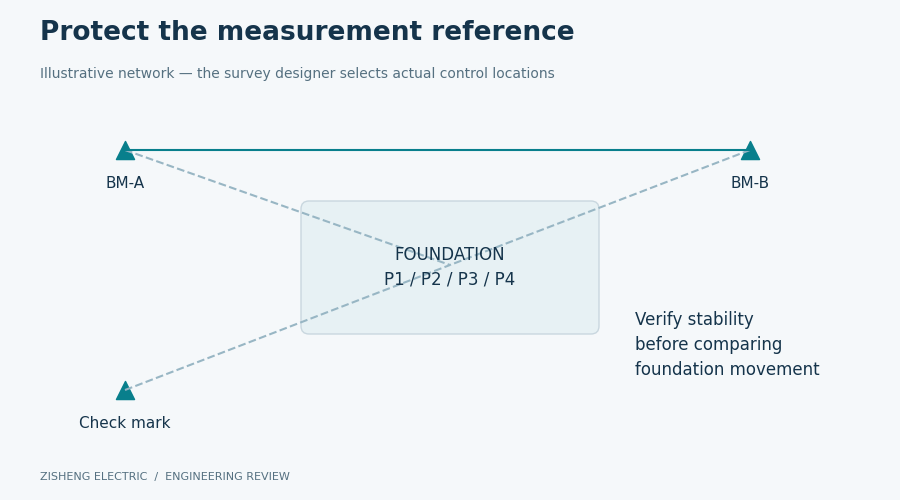
When a point is damaged, replaced or re-established, give the change a revision entry. Preserve the earlier measurements and explain whether the new point can be connected reliably to the old series. Do not silently substitute a new elevation or renumber a point while retaining its old trend. If continuity cannot be demonstrated, identify the new baseline and the limits of the comparison.
A useful field record separates the reading, its quality check and the engineering interpretation. This lets the reviewer see whether an apparent step occurred during a loading event, after a benchmark change or during a different survey setup. Those explanations have different implications for the next release decision.
An epoch is one defined measurement occasion. Give each epoch a date, time, point list and loading description. The approved plan should identify the baseline and subsequent stages, such as before placement, after the agreed assembly stage and before the specified handover gate. The actual interval should come from the designers and project conditions rather than a generic weekly rule.
Document instrument identity, calibration or verification status, the survey method and the checks appropriate to that method. Include the surveyor’s assessment of repeatability and uncertainty. Record relevant site conditions that could affect observations, access or interpretation, including recent excavation, heavy rainfall, nearby construction activity and any point damage.
Trimble’s Monitor Point Movement guidance describes comparing subsequent epochs with a reference epoch and earlier epochs. That distinction is helpful for handover: the report should show both cumulative movement from baseline and the change since the preceding accepted survey. A single latest elevation does not provide either comparison on its own.
Use a configuration note rather than the vague statement “transformer installed.” Identify whether the tank was in its shipping or final service configuration and whether separate accessories were supported independently. Record the addition or removal of temporary loads where relevant. The civil reviewer then has a usable history for comparing observed behaviour with the design assumptions.
If loading records are incomplete, mark that limitation in the report. The survey team should not invent missing construction dates to make a trend appear continuous. The EPC coordinator should recover the relevant delivery, assembly and inspection records and obtain the designer’s view on the resulting uncertainty.
Define the sign convention before presenting results. For example, downward settlement may be reported as a positive value relative to the baseline elevation. State this convention consistently in the tables and plots. Include the underlying elevation data so another reviewer can reconstruct the reported movement without guessing the arithmetic.
Total settlement describes movement at a point. Differential settlement describes the difference between the movements of selected points. A tilt estimate additionally depends on their separation and the assumptions used. These quantities should not share one unlabeled “settlement” column, particularly when the equipment has separate supports or a rigid connection to an adjacent structure.
As a deliberately simplified example, suppose P1 has moved downward by 4 mm and P2 by 7 mm from the same baseline. Their differential movement is 3 mm. These illustrative numbers are not allowable values. Their significance depends on point spacing, uncertainty, the foundation design, movement history and the limits of the connected equipment.
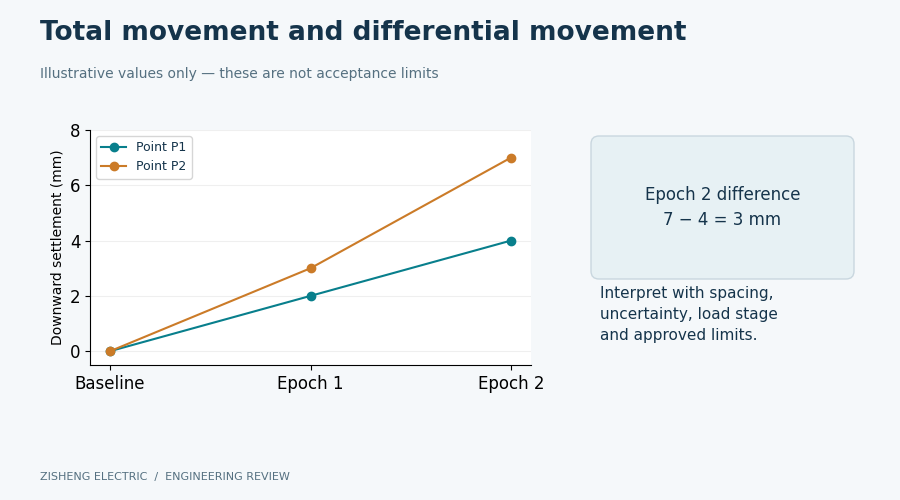
Do not treat small displayed digits as proof of equivalent measurement accuracy. Equally, a reading that is within a numerical threshold may still require review if the movement rate changes materially or the reference checks are doubtful. The surveyor should explain data quality; the responsible engineers should decide whether the evidence supports the proposed project activity.
The civil report and transformer inspection should refer to the same equipment configuration. Review accessible support interfaces, grout condition, anchors and adjoining structures against approved drawings and inspection procedures. Record cracks, gaps, displacement or other changes with point references and photographs. A survey identifies movement; it does not establish the cause of every visible defect.
Ask the equipment and connection designers to assess affected cable terminations, rigid bus connections, pipework and separately supported accessories. A flexible connection still has a specified arrangement and movement capability. Do not assume that slack, a bellows or an expansion joint makes every foundation movement acceptable.
The review should identify which party supplies each limit and who confirms compatibility. For an oil immersed transformer, the approved equipment drawings and connection data provide inputs to this discussion. For a substation transformer package, include the boundaries between the transformer, civil works and other supplied assemblies. Product descriptions do not replace the project interface documents.
The following table is a proposed coordination tool. Apply the actual project hold points, limits and approval authorities. Where evidence conflicts, retain the discrepancy and obtain a documented disposition before representing the affected activity as released.
| Observation | Evidence needed | Decision owner | Proposed next step |
|---|---|---|---|
| Reference checks are inconsistent | Control observations, point condition and survey quality review | Survey lead | Resolve the reference issue before accepting the movement comparison |
| Movement is within approved criteria with a credible trend | Comparable epochs, uncertainty and interface inspection | Civil/geotechnical designer and EPC release authority | Document the permitted next stage and continuing monitoring requirements |
| A limit is exceeded or the trend changes unexpectedly | Verified readings, loading history and engineering assessment | Responsible designers | Hold the affected release pending an approved disposition |
| A connected interface shows displacement or distress | Survey correlation, photographs and connection design review | Equipment and civil interface owners | Assess the specific connection and define inspection or remedial requirements |
| A monitored point is missing or replaced | Point revision record and continuity assessment | Survey lead and reviewing designer | Re-establish a defensible series and disclose any comparison gap |
An outlying reading should trigger the agreed response process, including verification where safe and appropriate. It should not automatically trigger jacking, anchor adjustment, grout removal or forced realignment of a cable or bus connection. Those activities can alter equipment loading and require a project-specific engineered method and the relevant manufacturer involvement.
Open an issue record that preserves the original observations, affected interfaces, temporary restrictions and named decision owners. Record any approved investigation or corrective work separately from the first survey. After completion, the designers should define the checks needed to support a new release, including whether further monitoring or a revised baseline is appropriate.
Keep the history visible after closure. Replacing a failed reading with a later satisfactory value loses the evidence of what happened and why the disposition was accepted. A useful closeout package links the original concern, approved action, subsequent measurements and final authorization.
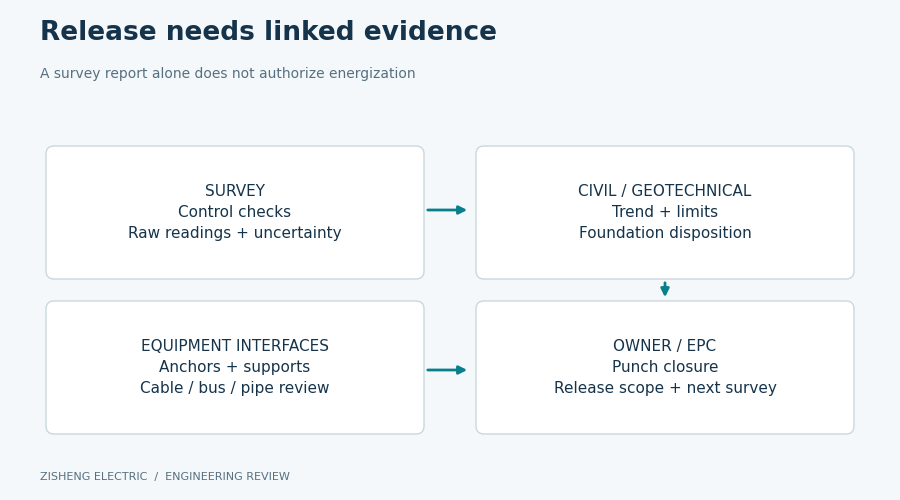
Assemble the approved monitoring plan, foundation and interface drawings, benchmark register, raw observations, processed results, quality checks, load-stage records and engineering dispositions. Include dated photographs that can be matched to the monitored points. Use consistent units, equipment tags and revision references across the survey report and punch register.
The handover index should show which records are final, which are superseded and which activities remain open. Give future monitoring an owner, access arrangement and reporting route. If a temporary monitoring arrangement will be removed, the successor arrangement should be accepted before that change breaks the measurement history.
Connect the civil release to the broader pre-energization commissioning test pack. Civil acceptance is one input to that process. It does not replace electrical testing, protection verification, operating permits or the owner’s authorization to energize.
A well-prepared transformer foundation settlement survey gives the owner an interpretable history and a clear decision trail. Zisheng Electric can discuss the transformer data and equipment interfaces needed by the EPC team, while the appointed civil and geotechnical designers retain responsibility for site-specific settlement criteria and foundation acceptance.

Build a substation system turnover package with clear boundaries, mechanical completion evidence, punch control and verified commissioning release records.
View details
Reconcile substation asset tags with approved equipment schedules, nameplates, drawings, FAT records and commissioning evidence. Use discrepancy classes, owner-controlled data rules and traceable closeout actions to build a usable EPC handover reg...
View details
Plan substation firestop handover with penetration registers, approved system references, staged inspection evidence and clear EPC release responsibilities.
View details
Plan transformer operator training for EPC handover with role-based sessions, current equipment records, practical scenarios and assessment evidence.
View details