 zishengelectric



news
News Center
Providing high-quality power to the world
Search productSearch post
news
Providing high-quality power to the world
Zisheng Electric treats transformer kiosk condensation as an interface between enclosure design, auxiliary power and site preservation. A marshalling kiosk can pass a wiring inspection in a dry factory and still develop moisture after delivery, particularly while the transformer is awaiting energization. The important procurement question is whether the assembled cabinet can manage the specified environment through every operating state.
This guide helps EPC engineers review the heater supply, humidity controls, cable entries and acceptance records for an outdoor transformer marshalling kiosk. It is a design and handover review, not an instruction to open or test energized equipment. Electrical inspection and functional testing belong to qualified personnel following approved isolation, equipment instructions and site procedures.
Condensation occurs when a surface is cold enough for water vapour in the surrounding air to condense on it. Rain entering through a damaged seal is a different mechanism, although both can leave similar marks. A larger heater does not repair a leaking gland plate. Equally, a cabinet that excludes direct rain can still contain humid air and experience cold surfaces during temperature changes.
Ask when moisture was observed, where it appeared and what had happened beforehand. Record door opening, rainfall, cleaning, recent cable work and the availability of auxiliary power. Photographs should distinguish the roof, door perimeter, entry plate, terminal area and lowest surfaces. A dry inspection on a warm afternoon cannot explain conditions during an earlier cool, humid period.
The existing substation water ingress walkdown guide addresses the wider building and drainage interfaces. For the kiosk, keep a separate moisture record so an enclosure defect is not closed merely because the surrounding civil work has passed inspection.
Provide the supplier with the specified ambient temperature range, humidity information, altitude and exposure to sun, wind-driven rain, dust or salt. Identify whether the cabinet is freestanding, attached to the transformer or sheltered by another structure. These details affect the enclosure assessment, but none establishes a universal heater wattage or humidity setting.
Include internal component losses for each operating condition. Heat produced by energized devices may disappear when control supplies are switched off. Pfannenberg’s enclosure-heating guidance identifies shutdown periods as a condensation concern when internal heat dissipation is lost. For procurement, this means the storage and outage cases need explicit review alongside normal service.
Distinguish at least four states: transport, site storage, installation before permanent auxiliary power, and normal operation with planned outages. For each state, name the party responsible for preservation and describe the approved arrangement. An installed heater provides no benefit while its circuit is unavailable. An assumed temporary supply is not a plan until its provision and supervision have an owner.
Do not connect preservation equipment to a convenient circuit without engineering approval. Supply voltage, protection, earthing, isolation and any temporary-power transition must match the project arrangement. The substation auxiliary power system review provides the broader load and source context; the kiosk review should identify the exact feeder and its status in each relevant case.
The following matrix turns a general requirement such as “provide anti-condensation heating” into reviewable evidence. Assign the actual contract responsibilities for each interface before releasing drawings.
| Review interface | Evidence required | Engineering decision | Reason to keep the item open |
|---|---|---|---|
| Environmental basis | Site conditions, enclosure location and operating-state schedule | Supplier confirms the cases covered by its assessment | Only normal energized operation is considered |
| Heater and layout | Selection basis, component data and internal arrangement | Heating and component temperature limits are compatible | Heater rating is copied without a documented basis |
| Control and sensing | Control principle, sensor position and approved settings | Control responds to the intended cabinet condition | Sensor location is dominated by a local heat source |
| Power availability | Feeder reference, protection and storage/outage arrangements | Preservation remains defined when normal supply is absent | Temporary supply responsibility is unassigned |
| Enclosure completion | Gland, gasket, blanking and approved accessory inspection records | As-installed enclosure matches the reviewed construction | Site drilling or spare openings remain unresolved |
| Verification and response | Functional evidence, observation limits and moisture escalation route | Owner accepts a maintainable and traceable arrangement | A single warm-cabinet observation is treated as complete proof |
Ask for a selection basis that identifies the enclosure dimensions, construction, exposure, internal losses and intended temperature or humidity-control objective. A heater chosen only by cabinet volume may overlook the actual installation. The supplier should explain which assumptions govern the selection and whether the design includes natural convection or a fan-assisted unit.
Review the heater’s permitted orientation, clearances, mounting arrangement and wiring against its own instructions. Leave the required paths for air movement. Cable ducts, document holders, spare components and later wiring additions can change the original arrangement. Photographs taken before those additions are not evidence of the final layout.
More heating is not automatically better. Nearby devices, cable insulation and accessible surfaces have temperature constraints. The review should also consider high ambient conditions and solar exposure, when the cabinet may need a different thermal response. Select the complete enclosure solution rather than adding a heater to compensate for every unresolved environmental question.
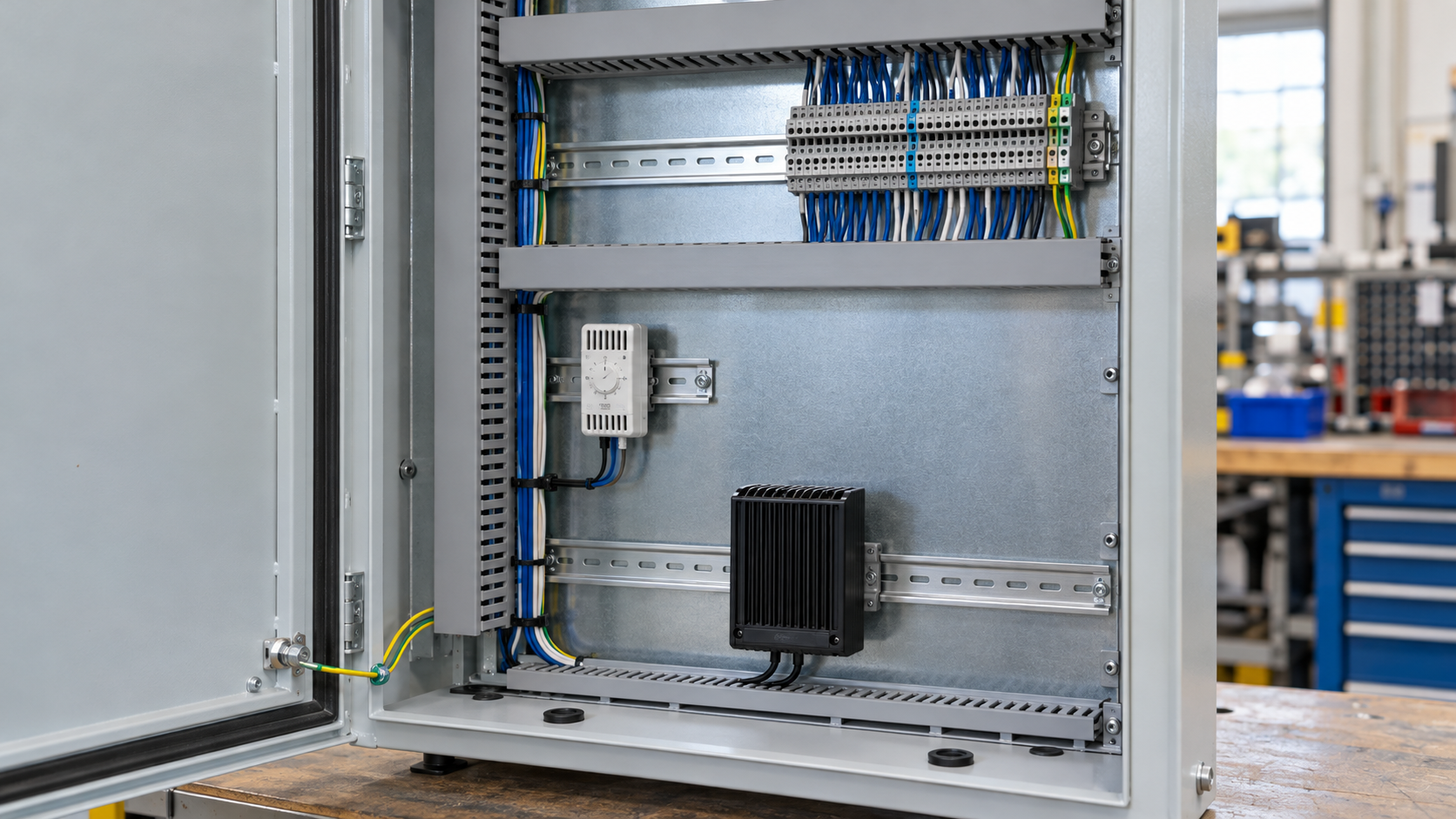
A thermostat responds to temperature; a hygrostat responds to relative humidity. Combined devices can incorporate both functions. STEGO’s hygrostat guidance describes humidity-responsive switching of enclosure heating. That operating principle does not make one catalogue setting suitable for every transformer kiosk.
Require the approved control logic, setpoints, switching behaviour and contact ratings in the submitted documents. If a contactor or other interface is needed, include it in the wiring review. Make sure the installed controller corresponds to the approved part rather than a visually similar device with different switching behaviour.
Sensor placement deserves its own drawing comment. A sensor directly influenced by a heater or another warm component may not represent cooler areas elsewhere in the enclosure. Ask the supplier to justify the location using the device instructions and cabinet arrangement. Do not move it during commissioning simply to obtain a preferred reading.
Record whether the project requires local indication, remote indication or an alarm. A feeder-healthy signal demonstrates something different from actual heater operation. If monitoring is required, define the condition being detected, the signal destination and the response responsibility. Avoid describing a general supply alarm as proof that every heater element is functioning.
Factory photographs often show blank entry plates; site photographs show the actual glands and cables. Acceptance must address the final condition. Compare cable outside diameters, gland selection, blanking components and plate details with the approved records. Verify that unused openings receive the specified closures and that cables are supported without imposing unintended strain on the entries.
Check the continuous condition of the door gasket, mating surfaces, hinges and closing mechanism. Dirt, trapped cable ties, damaged corners or an incorrectly seated gasket can compromise the assembly. Record repairs and the supplier’s disposition rather than applying an unspecified sealant and assuming the enclosure is restored.
Where the design includes drainage, ventilation or pressure-equalization accessories, confirm that they are approved for the enclosure and installed as specified. Do not add drilled drain holes or tape over designed openings as an informal moisture remedy. Changes can alter the reviewed enclosure performance and should pass through the project change process.
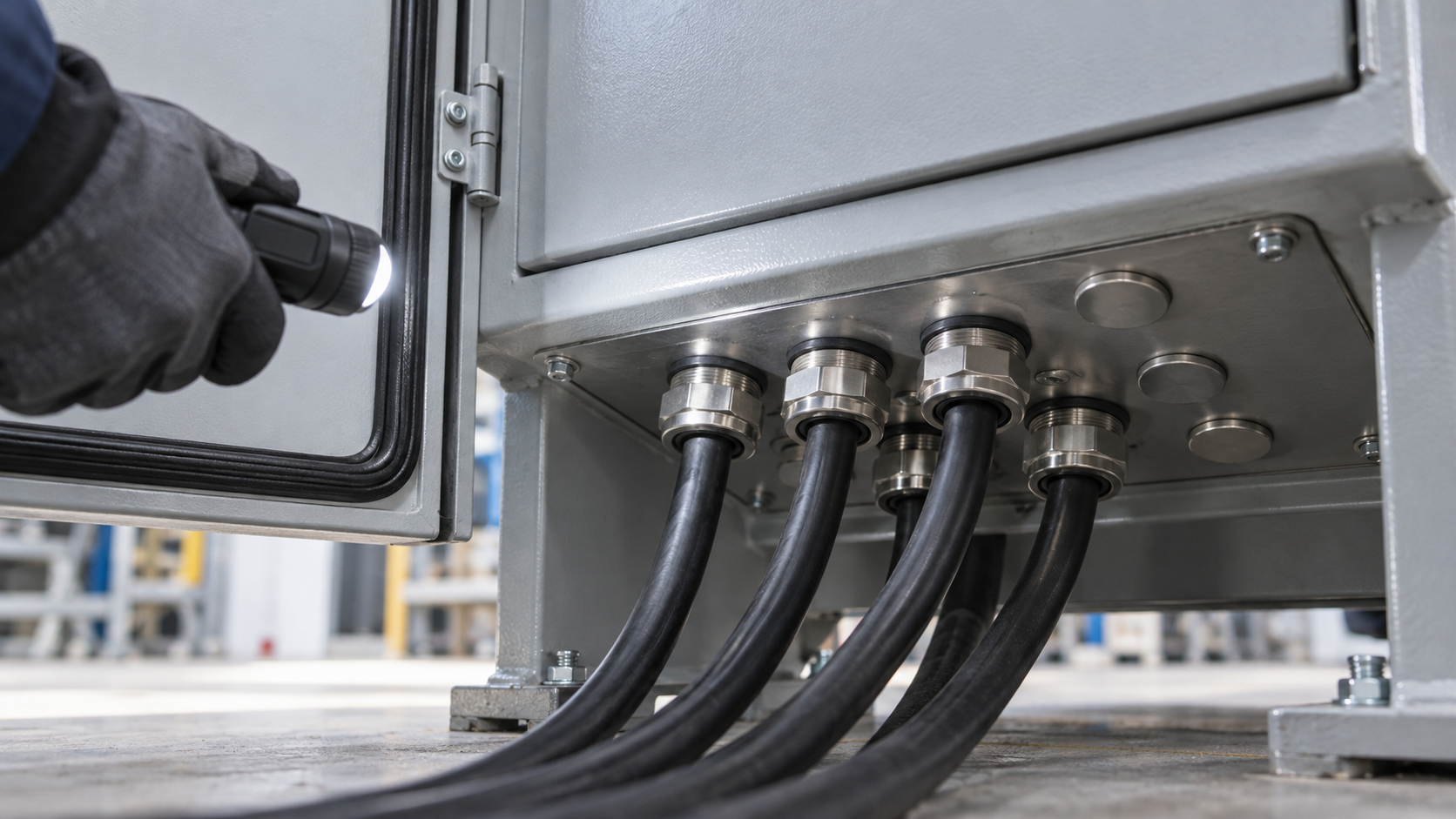
The mechanical inspection should identify the cabinet, installed components, wiring revision and enclosure changes. Functional evidence should show that the approved control sequence operates with the specified supply and connected heater arrangement. The authorized test procedure determines the safe method, instruments and acceptance limits; this article does not prescribe live probing or improvised humidity exposure.
A short functional test can demonstrate switching and operation under the tested conditions. It does not establish performance through every seasonal event. Keep these claims separate in the report. Record the test date, ambient conditions, supply state, controller settings and instrument identification so the result can be interpreted later.
If the contract calls for temperature and humidity logging, agree the instrument positions, logging interval, observation period and operating states beforehand. Include door-opening events and supply interruptions in the record. A sensor moved between readings or a logger placed near a local heat source can make a trend misleading.
Agree how untested conditions will be handled. For example, dry commissioning weather may not exercise the expected humid-season condition. The report should state that limitation and assign the agreed follow-up. It should not claim year-round validation from a short visit. Retain original observations alongside the reviewed summary.

When moisture is found, preserve the evidence before changing settings or cleaning the affected area. The responsible team should determine whether the likely mechanism is external entry, condensation, retained installation moisture or a combination. Identify any affected components and obtain the appropriate supplier and project disposition before return to service.
Close each finding with a cause assessment, corrective action, affected drawing or component reference, and defined reinspection evidence. If the cause is unresolved, record the limitation explicitly. An instruction to “monitor” needs an owner, observation method and escalation criterion; otherwise the original defect simply becomes the operator’s undocumented problem.
The handover package should contain the final internal layout, feeder reference, heater and controller datasheets, approved settings, enclosure inspection record, functional results and preservation instructions. Provide spare-part identification for replaceable heaters, controllers, glands and gaskets where included in the contract. Keep maintenance guidance specific to the supplied equipment.
No. Excluding external water and managing internal moisture are related but different duties. Require the supplier to address both the assembled enclosure and the specified operating conditions, including periods when auxiliary power is unavailable.
Only if the responsible engineering review supports that arrangement. Different cabinet construction, component losses, exposure and controls can require different decisions. Record the approved basis instead of adopting a familiar setting without checking the application.
Send the cabinet arrangement, auxiliary supply schedule, environmental specification, installation sequence and required acceptance evidence. State which enclosure accessories and monitoring functions are included, and identify who provides preservation before permanent auxiliary power becomes available.
For projects evaluating a 25 MVA oil-immersed substation transformer or a prefabricated substation package, Zisheng Electric can review the proposed equipment scope and auxiliary interfaces against the submitted requirements. These product examples do not establish the appropriate rating or cabinet configuration for a particular project.
For a transformer kiosk condensation review, provide drawings, datasheets, load lists, technical specifications and the single-line diagram, together with grid parameters, environmental conditions and installation-site constraints. Include anticipated storage duration, outage assumptions, utility interfaces, spare-parts requirements and service-support expectations so the review covers the period before energization as well as long-term operation.
Our engineering team will review the requirements and respond to project inquiries within 24 hours.
Review transformer sound level FAT reports: align acoustic metrics, cooling cases, measurement evidence and acceptance decisions before EPC release.
View details
Review substation cable trench cover acceptance through loading duties, frame support, panel fit, maintenance access and traceable EPC handover evidence.
View details
Plan transformer coating inspection for EPC projects: review paint records, thickness evidence, transport damage, compatible repairs and release boundaries.
View details
Build substation cable cleat acceptance evidence: connect fault-study inputs, product qualification, support details, spacing checks and EPC handover records.
View details