 zishengelectric





news
News Center
Providing high-quality power to the world
Search productSearch post
news
Providing high-quality power to the world
A transformer spare-parts package is often treated as a final commercial add-on. In an EPC project, it should be an engineered deliverable tied to commissioning, warranty, operating philosophy and the owner’s maintenance capability. Zisheng Electric recommends building a transformer spare parts strategy while the equipment specification and interface schedule are still open. That timing lets the project team connect every proposed spare to a credible failure mode, replacement task, storage requirement and replenishment lead time.
The objective is not to buy the longest possible list. It is to protect energization and early operation without filling a warehouse with items that will expire, degrade or never match the installed configuration. A useful strategy separates commissioning consumables, mandatory replacement items, operational spares, insurance spares and special tools. It also identifies who owns each item, where it will be stored, what preservation is required and how it will be controlled after handover.
All images in this article are AI-generated engineering illustrations. They do not show an actual customer project, warehouse, commissioning activity or Zisheng Electric facility.
Transformer spares affect more than maintenance. They influence the purchase specification, approved vendor list, FAT documentation, packing schedule, shipping volume, site storage and turnover dossiers. When the list is postponed until shipment, the project may discover that an accessory has a long procurement lead time, that a commissioning gasket kit was not included, or that the owner cannot store a sensitive component correctly.
Early planning also clarifies the commercial boundary. The main transformer supplier may provide parts fitted to the transformer, while the EPC contractor supplies oil-handling equipment, temporary hoses, test leads, lifting accessories or site consumables. The owner may already hold common relays, fans or instruments across a fleet. Without a responsibility matrix, two parties can purchase the same item while another critical item remains unassigned.
A disciplined process starts with the installed bill of materials and approved drawings. Generic catalogue descriptions are insufficient. A spare bushing, tap-changer drive component, pressure device, fan motor, gauge or gasket set must match the final type, rating, interface and material of the installed unit. If the design changes, the spare-parts schedule must follow the same document-control process.

Commissioning consumables support assembly, oil filling, inspection and initial energization. Depending on the design and site scope, the list may include approved gaskets and O-rings, sealing materials, oil-sampling bottles, desiccant, touch-up coating, cleaning materials and specified quantities of compatible insulating liquid. These items are used or opened during site work and should not be confused with the owner’s long-term operational stock.
The project should estimate quantities from the actual erection method and shipping split. A transformer shipped with radiators, bushings or conservator removed has different site-consumable needs from a unit transported largely assembled. The method statement, packing list and commissioning plan should therefore be reviewed together.
Operational spares are intended for foreseeable maintenance during the agreed operating period. Candidates can include cooling fan motors, pumps where fitted, temperature indicators, level indicators, pressure devices, control relays, contactors, space heaters, lamps, fuses, filter elements and selected tap-changer service components. The correct list depends on redundancy, duty cycle, installed population and the owner’s maintenance philosophy.
A fan motor may be a sensible spare when several identical fans operate at a remote site. It may be unnecessary when the owner already stocks an approved fleet-standard motor and the transformer interface is identical. The EPC team should record that decision rather than deleting the line without explanation.
Insurance spares address low-probability events with severe outage consequences and long replacement times. High-voltage bushings, special current transformers, tap-changer assemblies or major cooling equipment may fall into this class for some projects. They should not be selected by habit. The owner needs a consequence assessment that considers transformer redundancy, system restoration options, installed fleet commonality, supply lead time, repair capability, transport constraints and the expected service life of the stored part.
Insurance spares require a stronger business case because their purchase, storage and periodic inspection can be expensive. A spare that cannot be preserved, tested or transported when needed creates false confidence.
| Decision factor | Evidence to review | Procurement implication | Risk if ignored |
|---|---|---|---|
| Failure consequence | Single-line diagram, redundancy, critical load and restoration plan | Prioritize items that can block energization or extend a critical outage | Low-value failure causes disproportionate downtime |
| Replacement lead time | Manufacturer confirmation, customization level and transport route | Order long-lead matched components with the main equipment | Emergency procurement cannot meet restoration target |
| Installed population | Number of identical transformers and common accessory types | Pool compatible spares where technically and contractually acceptable | Duplicate stock or insufficient coverage |
| Storage sensitivity | Packaging, humidity, temperature, shelf-life and test instructions | Provide preservation method, storage facility and inspection interval | Spare degrades before it is required |
| Change control | Approved drawings, final bill of materials and deviation register | Link each spare to the as-built component and revision | Delivered spare does not fit the installed unit |
| Maintenance capability | Owner skills, lifting facilities, test equipment and service agreement | Include special tools, procedures or service support where necessary | Part exists but cannot be safely replaced |
| Commercial boundary | Supply scope, exclusions, Incoterms, warranties and turnover plan | Assign purchaser, custodian and replenishment responsibility | Gaps, duplication or warranty dispute |
The spare-parts schedule should use the same tag numbers and document references as the transformer. For every line, record the equipment tag, installed component description, manufacturer and model where approved, electrical and mechanical rating, quantity installed, spare quantity, storage location, preservation instruction and cross-reference to drawings or manuals.
Interchangeability must be demonstrated, not assumed. Two gauges with the same dial range may use different switch contacts, capillary lengths, mounting threads or alarm settings. Fan motors can differ in supply voltage, power, shaft dimensions, enclosure rating and connector arrangement. Bushings can differ in insulation level, current rating, terminal connection, CT arrangement and mounting interface. A procurement description that omits those details invites an unsuitable substitute.
This is one reason the spares schedule should be reviewed alongside the substation cable interface schedule and the approved control schematics. Auxiliary components may need terminal, cable-gland, signal and control-voltage compatibility.
Delivery does not complete the spare-parts obligation. The receiving team should verify quantities, identity, condition, packaging and documentation before accepting the items into storage. Sensitive parts may require sealed packaging, desiccant, humidity indicators, protective caps, upright orientation, shock protection, controlled temperature or periodic inspection. The manufacturer’s approved instructions should govern.
Each package needs an external identifier that can be matched to the schedule without opening preservation unnecessarily. The register should capture receipt date, inspection result, shelf-life where applicable, next preservation action and any quarantine status. If a crate is opened for verification, the team should document how and when it was resealed.
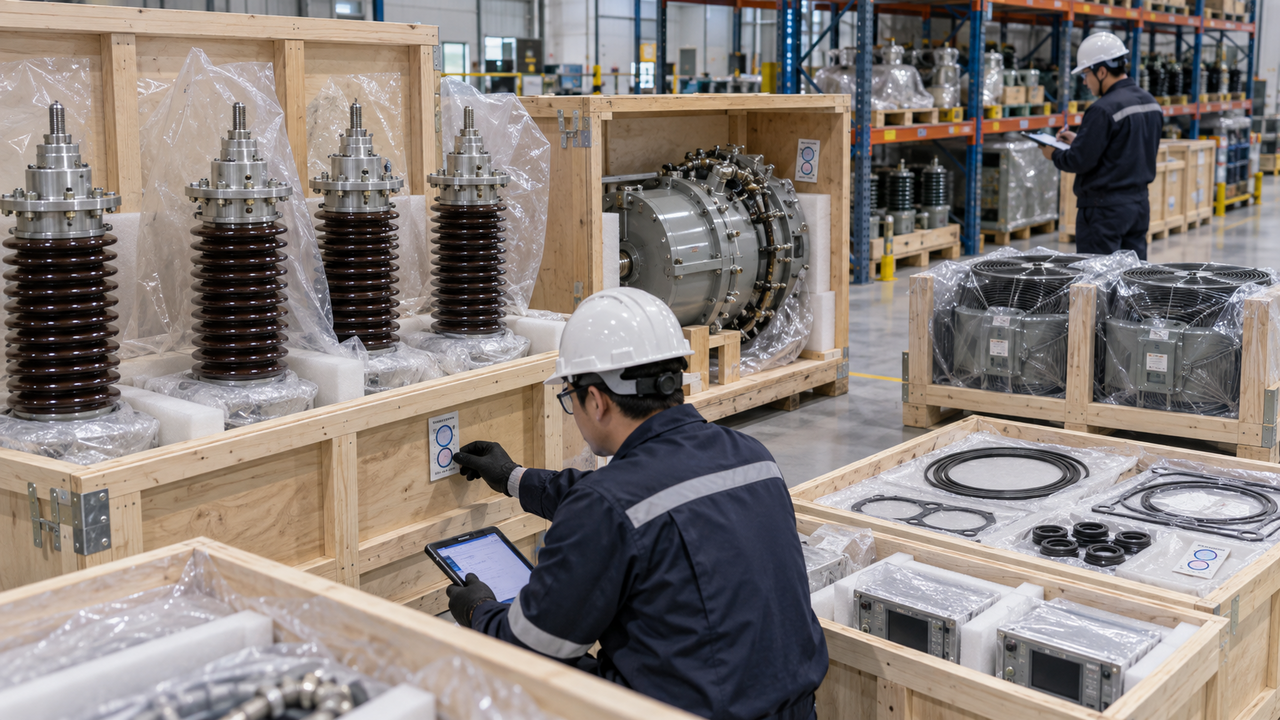
The receipt process should align with the project’s transformer transport damage inspection procedure. Both require clear photographic evidence, discrepancy reporting and responsibility for corrective action. However, receiving acceptance must not be confused with technical approval for installation.
A spare part is useful only if the owner can install and verify it safely. The equipment supplier and EPC contractor should identify special lifting fixtures, bushing handling tools, tap-changer service tools, torque multipliers, oil-hose adapters, filling connections, test plugs, programming cables and proprietary software or licenses required for maintenance. Common workshop tools do not need to be repackaged as special tools, but unique interfaces must be controlled.
Calibration requirements also matter. Test equipment delivered at project handover may need a valid certificate, storage case, batteries, leads and operating instructions. If the owner will use its own instruments, the method statement should state the required measurement range and accuracy so that the maintenance task is not dependent on an unidentified supplier tool.
The transformer inspection and test plan should include a point for verifying the final spares list, identity, quantities, packaging and documentation. This can be coordinated with the project’s transformer inspection and test plan, but the acceptance evidence for spares should remain visible in the turnover dossier.
Commissioning personnel need a controlled issue process. If a gasket or instrument is taken from the operational-spares stock during erection, the register should show the withdrawal and replenishment requirement. Otherwise, the owner may receive a signed handover list that no longer matches the physical inventory.

At handover, the owner should receive the approved schedule, certificates where applicable, preservation instructions, storage map, inspection history, shelf-life data, special-tool list and replenishment status. Training should cover identification and preservation as well as replacement. The same asset-management reference should appear in the maintenance system so that parts are not lost after the EPC document portal closes.
Assumed example only — not a real project: an EPC project includes two identical grid transformers with duplicated cooling groups. The owner can operate temporarily with one fan out of service, but the site is remote and delivery is slow. The team selects one compatible fan motor and one control contactor as pooled operational spares, plus commissioning gasket kits based on the planned shipping split. A high-voltage bushing is evaluated separately as an insurance spare because of its outage consequence and replacement lead time.
The schedule records the final bushing type only after design approval. It also requires indoor protected storage, periodic visual checks and the manufacturer’s handling instructions. This example shows the method, not a universal quantity. Another project with transformer redundancy, nearby service resources or an existing common spares pool could reach a different decision.
The final list must match the actual equipment, whether the project uses a 110 kV/115 kV power transformer, a 132 kV/138 kV power transformer or a 220 kV/230 kV power transformer. Product pages show available equipment categories; they do not define the spare quantities or interfaces for a specific contract.
To prepare a project-specific transformer spare parts strategy, send Zisheng Electric the drawings, data sheets, load list, technical specification, single-line diagram, network parameters, environmental conditions and installation-site constraints. Include the required operating-spares period, transformer redundancy, target restoration time, existing fleet standards, storage conditions and maintenance resources. Our engineering team will review the requirements and respond to project inquiries within 24 hours.
Engineered Transformer Systems That Match Your Project Specifications A power system is only as strong as its weakest link. With over 15 years of manufacturing experience and transformers operating in more than 40 countries, we've seen how the rig...
View details
Oil immersed transformers are used in power transmission and distribution systems where reliable voltage conversion is required. The transformer core and windings are submerged in insulating oil, which provides both electrical insulation and heat ...
View details
Reliable Transformer Supply for Renewable Energy, Industrial, Utility, and Infrastructure Projects For EPC contractors, the decision of which transformer manufacturer to work with can shape how the entire project unfolds. A transformer is just one...
View details
Specify a transformer oil preservation system for EPC projects, covering conservator sizing, bladder selection, breathers, oil-level alarms, FAT, transport, site assembly and commissioning evidence.
View details