 zishengelectric





news
News Center
Providing high-quality power to the world
Search productSearch post
news
Providing high-quality power to the world
Zisheng Electric plans a transformer first-service thermal survey as an operational handover check, not a substitute for factory tests or protection commissioning. A transformer that has passed those gates still needs a defensible baseline under its first representative load. The EPC contractor and owner should agree what can be observed safely, what loading and ambient conditions will be recorded, and who decides whether a finding requires action. A colorful infrared picture without context does not answer any of those questions.
For a new substation or an upgraded industrial supply, the first-service window may be short. Production loads rise unevenly, cooling stages change, and access rules tighten after energization. The survey should therefore start as a planned interface between operations, commissioning, the transformer supplier, the thermographer and the protection engineer. It should leave the owner with traceable observations and an escalation route, not an unexplained collection of images.
The survey asks whether observable surfaces and accessible connections behave consistently with the approved design and comparable phases at a documented operating point. It can flag a connection, cooling bank, cable termination or auxiliary circuit for investigation. It cannot prove internal winding temperature from an external image, identify a particular fault mechanism by color alone, or certify an entire installation as healthy. Those distinctions protect decisions from the false precision of one snapshot.
The first decision is whether the load is sufficiently representative to establish a useful baseline. A plant that has only energized auxiliary systems has not exercised the transformer in the same way as the eventual duty. The second decision is whether an apparent difference is attributable to load, sunlight, viewing angle, surface finish, cooling status or a genuine defect. The third is who owns a follow-up inspection or outage if the observation remains credible. Record the answer and its evidence.
A coordinated condition-monitoring interface helps link the survey to available oil and winding-temperature indications, fan status, load records and operating event logs. The infrared image is one input among several. Its value increases when the owner can retrieve the matching operating data later.
Only authorized, competent personnel should plan and conduct observations of energized installations under the owner’s approved electrical-safety procedures. Establish access permission, exclusion zones, the equipment state, permit requirements and an emergency contact before the visit. Do not open a panel, bypass an interlock or remove a cover simply to obtain a better image. If the safe line of sight is inadequate, record the limitation and arrange an approved alternative inspection method or outage. The UK Health and Safety Executive’s guidance on work with electrical equipment reinforces that electrical work requires appropriate control of risk and competent people; local rules and owner procedures govern the actual site.
The scope should list the tank, radiators, accessible bushing and cable connections, terminal boxes, neutral connections, auxiliary supplies and any specified switchgear interfaces. Every item needs an agreed observation point. A painted tank surface and a shiny metallic connector will not behave the same way under an infrared camera. Outdoor equipment can also reflect sunlight or nearby hot surfaces. The survey plan should say which surfaces are suitable for comparative observations and which require another method.
The transformer manufacturer may own an internal connection or cooling assembly, while the EPC cable contractor owns a field-installed termination and the operator owns switching access. The transformer earthing interface illustrates why a single photograph rarely assigns responsibility: conductor routing, bonding, neutral equipment and test links can involve several contractors. Use the approved drawings, installation records and a named owner for each observation; do not turn an uncertain thermal image into a vendor claim.

A comparison between two phases has meaning only when the conditions are comparable. Record transformer identification, date and time, camera identification, observer, distance and viewing angle. Capture the simultaneous current on each relevant phase, operating tap position, cooling stage, ambient conditions and recent load trend where available. If the plant load is cyclic, note the time since a major change. An image taken immediately after a step load should not be compared uncritically with one taken after a stable operating period.
Teledyne FLIR explains that infrared inspections can be made while electrical assets operate under load and that temperature differences need documented comparison. Its utility thermography overview is useful background, though any acceptance criterion still belongs to the project specification, equipment manufacturer and owner. Surface emissivity, reflected background temperature, optics and distance affect an indicated temperature. Keep raw radiometric files when the camera supports them, as well as a visible-light orientation photograph that identifies the component without exposing confidential site information.
Record if direct phase-to-phase comparison is impossible because one phase has a different physical arrangement or sunlight exposure. A photograph showing an apparently warmer phase is a prompt to investigate, not an automatic rejection. If the load is too low or too short to reveal a likely resistive defect, call the outcome an incomplete baseline and schedule another observation at a suitable operating point.
| Observation area | Evidence to capture | Why it matters | Decision or follow-up |
|---|---|---|---|
| Bushing and external connection | Comparable-phase image, visible-light identification, phase current, angle and surface condition | A local difference may indicate a connection problem but reflections and unequal loading can imitate one | Correlate with installation records; owner authorizes any intrusive check |
| Tank and top-oil indication | Surface pattern, ambient, top-oil reading, tap and recent load | The external surface does not directly measure winding hot spot | Compare against approved operating data and trend; avoid image-only diagnosis |
| Radiator and cooling bank | Bank images, fan/pump state, control mode and corresponding temperature trends | An inactive or obstructed bank can reduce cooling effectiveness | Check control feedback and approved cooling scheme before maintenance decision |
| Cable box or switchgear interface | Safe accessible view, phase load, termination ownership and installation record | Field-installed interfaces may not be under transformer supplier scope | Escalate to responsible contractor; use approved isolation for internal examination |
| Auxiliary and monitoring circuit | Accessible enclosure surface, circuit identity, heater/fan state and alarm history | A local thermal concern may arise in ancillary equipment rather than transformer core | Correlate with electrical drawings and protection/SCADA records |
This is a decision framework, not a universal temperature-limit table. Contractual limits, design data, reference measurements and the owner’s maintenance policy determine what is acceptable. The team must avoid inserting a generic delta-temperature threshold into a report and calling it a manufacturer guarantee.
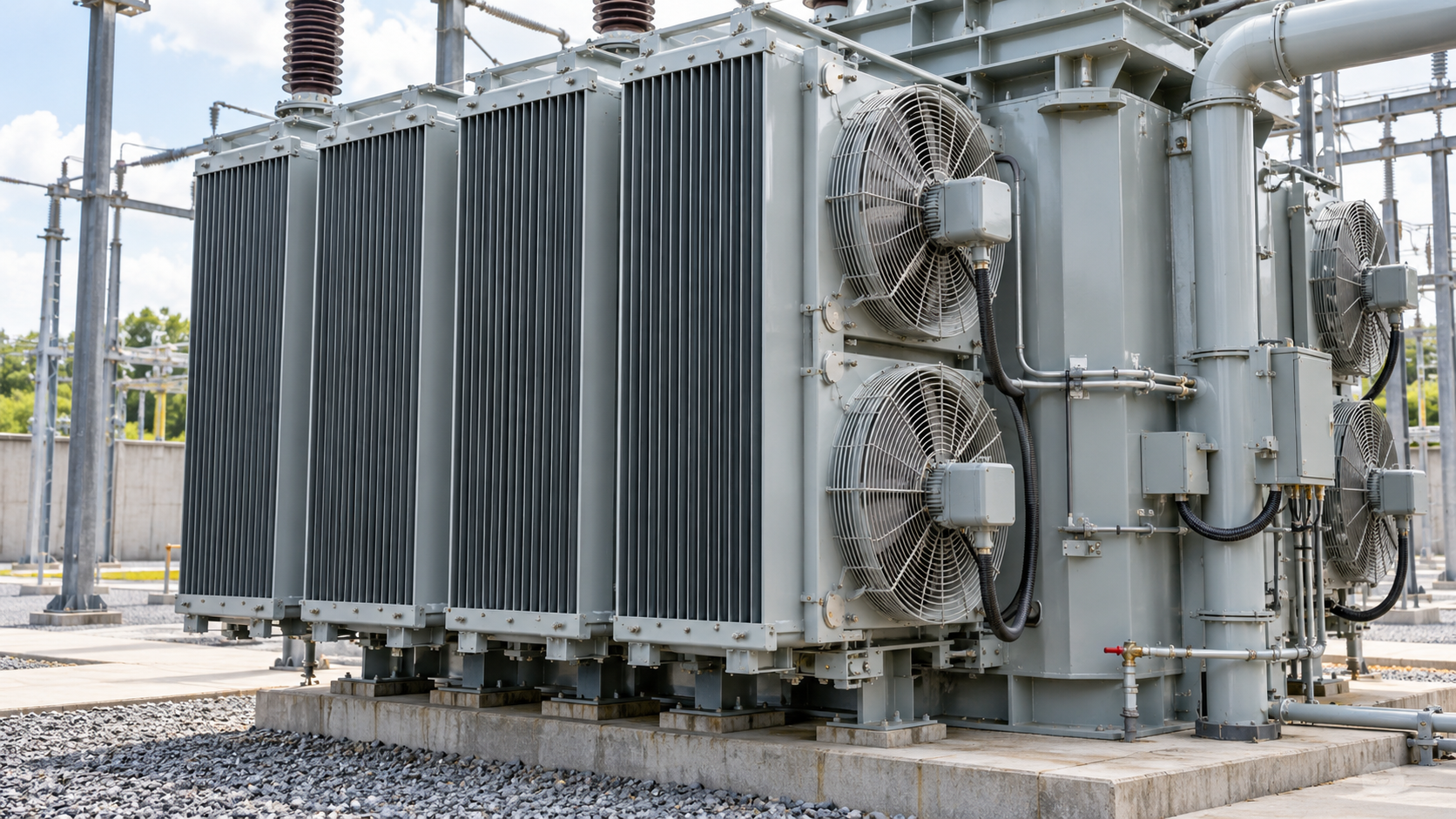
Radiator banks are a good example of why images need operating context. In natural cooling, flow patterns can vary as the transformer warms. With forced cooling, the reported fan or pump command should be distinguished from actual feedback. Confirm which stage was requested, which devices ran, and whether an alarm or power-supply failure was present. A radiator appearing cooler than its neighbors may be normal in one configuration or evidence that a bank is not participating; it cannot be judged without the approved hydraulic and control arrangement.
The commissioning team should be able to match a thermal observation to the cooling-control drawings and test records. If a fan did not start, the finding may be wiring, supply, control logic or the fan itself. If a temperature indicator differs from the observed surface pattern, consider calibration and placement before declaring a transformer fault. The supplier’s equipment data and the protection interface plan identify alarm and trip ownership. Never change a protective setting or defeat an alarm to make the survey appear acceptable.
For a project considering an 110–115 kV power transformer or a 35–46 kV power transformer, specify the expected cooling arrangement and accessible observation routes during procurement. Retrofitting safe access and data capture after the bay is commissioned can be more difficult than adding these requirements to the initial layout review.
An external thermal image can show a surface pattern; SCADA supplies trends and timestamps; protection relays record electrical events. None should be silently substituted for the others. A high indicated temperature at a cable termination may correlate with phase current imbalance, an abnormal ambient condition or a recent switching event. If corresponding load and alarm records are unavailable, state the limitation. A definitive failure diagnosis is premature.
A finding register should include an equipment tag, exact observation point, severity rationale, captured evidence, responsible discipline, next action and closure evidence. Distinguish an immediate operational concern from a trend item and a documentation gap. A severe unexplained observation may require the owner to consider load reduction or controlled isolation under its operating procedure; the survey author should not issue an unsanctioned switching instruction. Retesting after corrective work should reproduce, as far as practical, the initial viewing and load conditions so that a change has meaning.
When the survey concerns a prefabricated substation, consider the enclosure ventilation and access boundaries as well as the transformer itself. A prefabricated substation solution is only relevant to this comparison if its installed airflow path and operating configuration are documented. A hotspot outside a closed room cannot be assumed to describe the internal equipment condition.
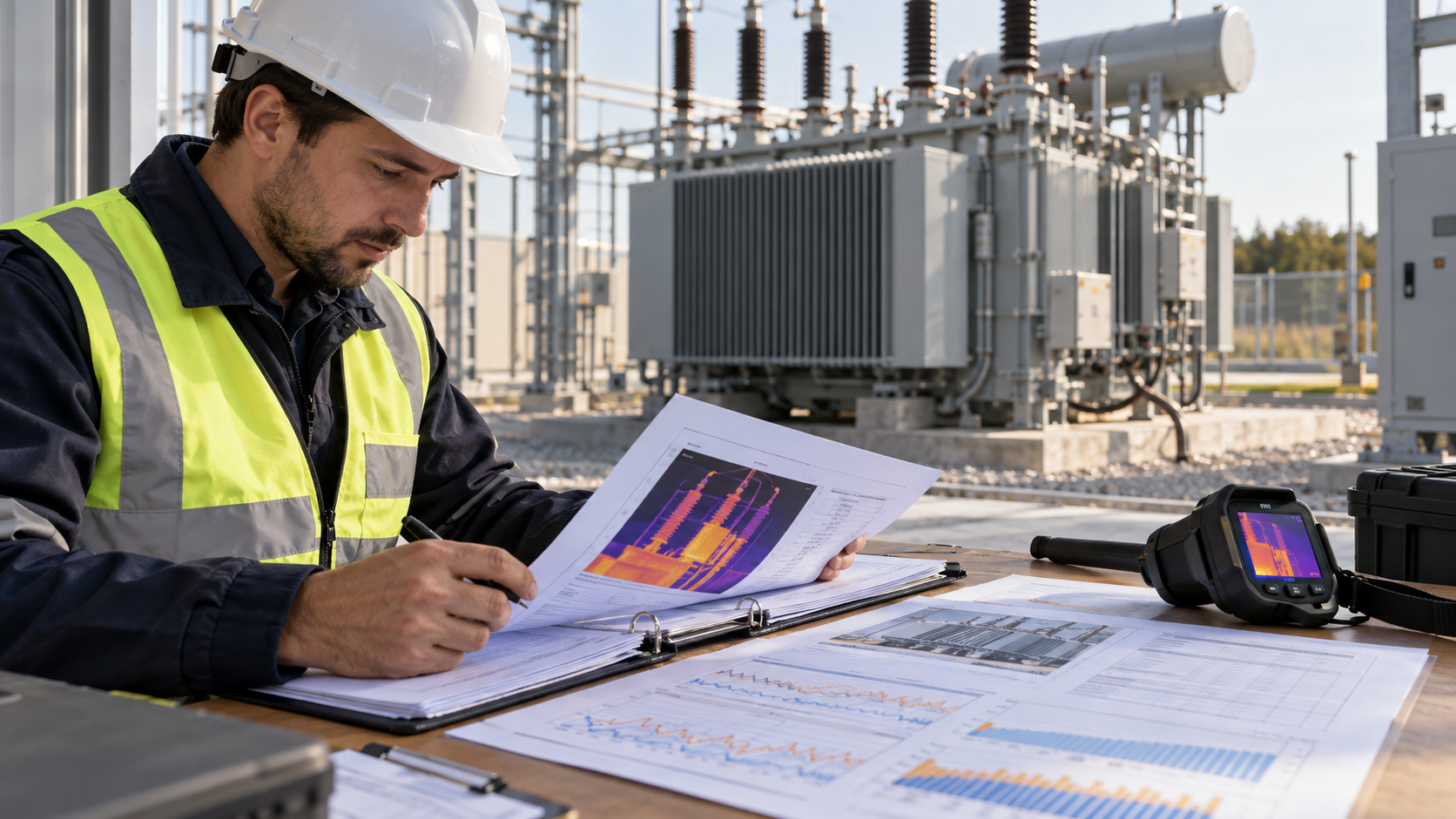
At handover, provide a location plan showing each camera view, raw files where available, visible-light reference images, instrument details, load and environmental records, operating logs, and a finding register. Include the approved single-line diagram, relevant equipment data sheets, cooling scheme, as-built cable and earthing drawings, and a list of any points that could not be safely inspected. The owner should know which baseline images are comparable with later maintenance surveys.
Commissioning completion is not the same as condition baseline completion. If commissioning occurs at minimal load, mark the baseline provisional and assign a future review trigger tied to representative operation. Record who is responsible for arranging access and how the findings will enter the maintenance system. A report that merely states “all normal” without load, camera position or reviewed interfaces will have little value when a future engineer compares the asset after an event.
Before approving release, the owner should ask: Which evidence supports the conclusion? Was a comparable component available? Did the load represent planned service? Were environmental effects considered? Has every unresolved issue been assigned an owner and due date? If the answer is no, release may still be possible under a documented plan, but the team should not represent the survey as a complete, unconditional pass.
A repeat may be appropriate after the first sustained production duty, a cooling-control repair, a field termination rework, a material change in loading or a protection event. Timing is project-specific. Use the owner-approved procedure and manufacturer information, not a blanket calendar interval invented for every installation. Baseline files should be retained in a format that the operations team can open without relying on one contractor’s temporary account.
Where a warm spot cannot be viewed again under comparable conditions, write that limitation explicitly. Consider complementary evidence such as load trends, inspected torque records from a planned outage, oil-temperature data, fan feedback and laboratory tests where appropriate. A thermal survey is valuable because it narrows the questions for engineering review; it is not proof that unseen internal components are defect-free.
Zisheng Electric can coordinate the transformer first-service thermal survey interface with the supplied power transformer and the project’s substation configuration. To define a workable scope, send the drawings, data sheets, load lists, technical specifications, single-line diagram, grid parameters, environmental conditions and installation-site conditions. Include the proposed observation routes, operating schedule and owner safety rules. We can then identify what the transformer supply package can document and what requires the EPC contractor or operator to provide evidence. Our engineering team will review the requirements and respond to project inquiries within 24 hours.
Full-cycle EPC transformer service covering design freeze, manufacturing, FAT, overseas logistics, on-site installation and commissioning for Middle East and Africa power projects.
View details
Plan transformer operator training for EPC handover with role-based sessions, current equipment records, practical scenarios and assessment evidence.
View details
Build a transformer DGA baseline for EPC handover: connect oil history, sample identity, laboratory methods and first-service review responsibilities.
View details
Plan transformer temperature instrument calibration at EPC handover. Review oil and winding indications, alarm contacts, remote signal scaling, reference evidence, test hold points and release decisions with Zisheng Electric.
View details