 zishengelectric



news
News Center
Providing high-quality power to the world
Search productSearch post
news
Providing high-quality power to the world
Specify an on-load tap changer when the project needs transformer ratio adjustment while supplying load. A de-energized tap changer is an option when the required setting can be established with the transformer safely taken out of service. For an EPC enquiry to Zisheng Electric, that operating requirement should come before a preferred mechanism or a price comparison.
This distinction matters to package buyers as much as electrical designers. Two offers with the same transformer rating and tapping range can provide very different operating capabilities. The cheaper offer may simply exclude the equipment needed to regulate voltage during normal service.

A winding tap is a connection to a selected number of winding turns. Selecting another tap changes the transformer’s voltage ratio. It does not turn the transformer into an unlimited voltage source, and it does not increase its permitted loading automatically. The approved tapping schedule must state the usable positions and their ratings.
An on-load tap changer, usually abbreviated OLTC, is designed to change taps under its specified energized operating duty. A de-energized tap changer, or DETC, requires the transformer to be switched off for adjustment. Reinhausen’s DETC guidance makes this operating distinction explicit. An unloaded but energized transformer is not a safe substitute for a de-energized transformer. Isolation, verification and the manufacturer’s operating instructions still apply.
| Buyer question | DETC proposal | OLTC proposal |
|---|---|---|
| Can supply be interrupted for an adjustment? | Requires an approved outage and safe isolation | Can adjust during service within specified duty |
| Is automatic voltage regulation required? | Does not provide live automatic tap regulation | Needs a defined regulator and measurement package |
| What must the EPC coordinate? | Tap schedule, setting access and operating procedure | Those items plus drive supplies, control, alarms and interfaces |
| How should maintenance be priced? | Use the actual mechanism’s instructions | Include the specified mechanism, drive and control maintenance scope |
Neither column is a universal recommendation. A stable supply and infrequent planned adjustments may support a DETC solution. A process that cannot tolerate outages for routine voltage correction may justify an OLTC. Confirm this with the system designer; voltage variation at the load can also arise from feeder impedance, starting currents or upstream operating conditions.
An OLTC mechanism and an automatic voltage regulator are different parts of the solution. The regulator decides when a tap movement is required using the measured voltage and approved settings. The mechanism performs the movement. A quotation that includes the first does not necessarily include the second.
Ask each bidder to identify the regulator supplier, measurement source, motor-drive supply, local controls, remote commands and position indication. Establish who supplies the wiring and who proves the complete chain. For detailed coordination after the equipment choice, use the OLTC control interface guide.
Reinhausen’s OLTC portfolio illustrates why a generic “OLTC included” note is incomplete: mechanisms have defined current, step-voltage and application limits. The transformer manufacturer must select the arrangement for the proposed design. Do not copy a device rating from another project.
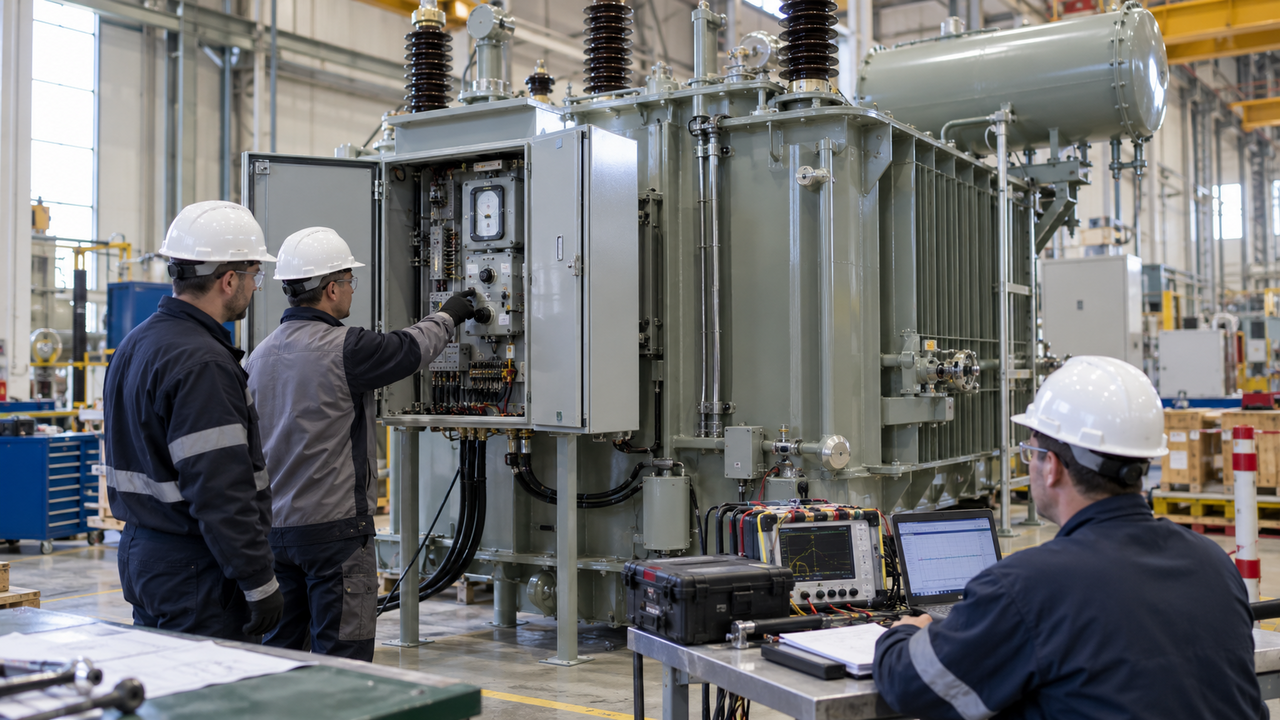
Consider a hypothetical tender for a plant that must maintain supply while correcting recurring voltage changes. Bid A offers a DETC and Bid B offers an OLTC with a drive, but no regulator. Neither offer should be marked fully compliant with automatic regulation solely because it includes a tapping range.
The buyer should ask Bid A for an alternative meeting the live regulation requirement. For Bid B, request a priced and technically defined regulator interface. The final comparison then covers equivalent functionality. This example describes a procurement decision, not a Zisheng Electric delivery or a measured performance result.
Agree the last item before the witness visit. A mechanism test alone does not demonstrate every remote command or automatic-control interface. The FAT witness plan should identify what is proved at the factory and what remains for site integration.
For a 110kV–115kV power transformer enquiry, send Zisheng Electric the voltage range, load profile, permitted outages and proposed control responsibility. Include parallel-operation requirements if applicable. These inputs allow the engineering discussion to establish whether a DETC is adequate or an OLTC package is needed, without treating the more complex option as automatically better.
Compare VPI and VPE transformer offers by resin, processing, environmental duty and guaranteed performance. Learn which supplier evidence makes an EPC comparison useful.
View details
Specify transformer impedance tolerance for EPC procurement: compare guaranteed limits, study margins, parallel loading and FAT deviations before release.
View details
Check transformer efficiency claims using load, power factor and loss data. Follow a worked calculation and request the evidence needed for EPC technical approval.
View details
Compare mineral oil and natural ester transformers by fire requirements, cooling design, cold operation, preservation systems and EPC procurement documents.
View details