 zishengelectric



news
News Center
Providing high-quality power to the world
Search productSearch post
news
Providing high-quality power to the world
BIL describes a transformer’s insulation withstand under a specified impulse test; it is not the voltage at which the transformer can operate continuously. For a Zisheng Electric enquiry, record the operating voltages and the required insulation levels as separate entries. That simple distinction prevents a large test-voltage number from being mistaken for a usable supply rating.

This guide is for buyers reading a supplier datasheet before the electrical engineer completes approval. The practical task is to identify what the number applies to, which test definition supports it and whether the offer answers the project specification.
BIL commonly refers to basic lightning impulse insulation level. It expresses insulation capability against a prescribed transient voltage stress. The impulse has a defined shape and duration; it is not a sustained alternating supply. A declaration such as 95 kV BIL therefore cannot be read as permission to connect a winding to a 95 kV operating system.
Operating voltage, highest voltage for equipment and insulation test levels answer different questions. The first describes the intended electrical service. The equipment voltage designation supports insulation selection within the applicable standard. The test levels describe particular stresses the insulation must withstand under specified conditions. Ask the supplier to label each field instead of combining all three under “voltage.”
Lightning impulse withstand is normally stated as a peak value. A power-frequency withstand declaration uses its own voltage convention, duration and test arrangement. These are separate tests. Dividing or multiplying one number by a familiar conversion factor does not establish the other withstand capability.
| Datasheet entry | Buyer interpretation | Clarification to request |
|---|---|---|
| Rated winding voltage | Intended service voltage at the identified winding | Voltage ratio, frequency and tap basis |
| BIL or lightning impulse withstand | Specified impulse insulation capability | Applicable terminal, peak value and test reference |
| Power-frequency withstand | A different dielectric test requirement | Test connection, value and duration |
| Insulation thermal class | Thermal insulation-system designation | Separate temperature-rise and service conditions |
The last row is particularly easy to confuse in dry-type offers. The insulation class and temperature-rise guide explains the thermal terms. A thermal class does not replace an impulse withstand declaration.
A transformer may have more than one voltage system and different terminal insulation requirements. A single unqualified BIL value can leave the low-voltage side or neutral undefined. Request a schedule that identifies the relevant line terminals and neutral, where applicable, together with the standard and edition used.
IEC 60076-3 addresses insulation requirements and corresponding tests with reference to particular windings and terminals. Its public scope is useful for understanding why terminal identity matters. It does not justify assigning a test value to a project without reviewing the applicable requirements. An IEC offer and an IEEE-based enquiry need an explicit reconciliation of terminology and test obligations.
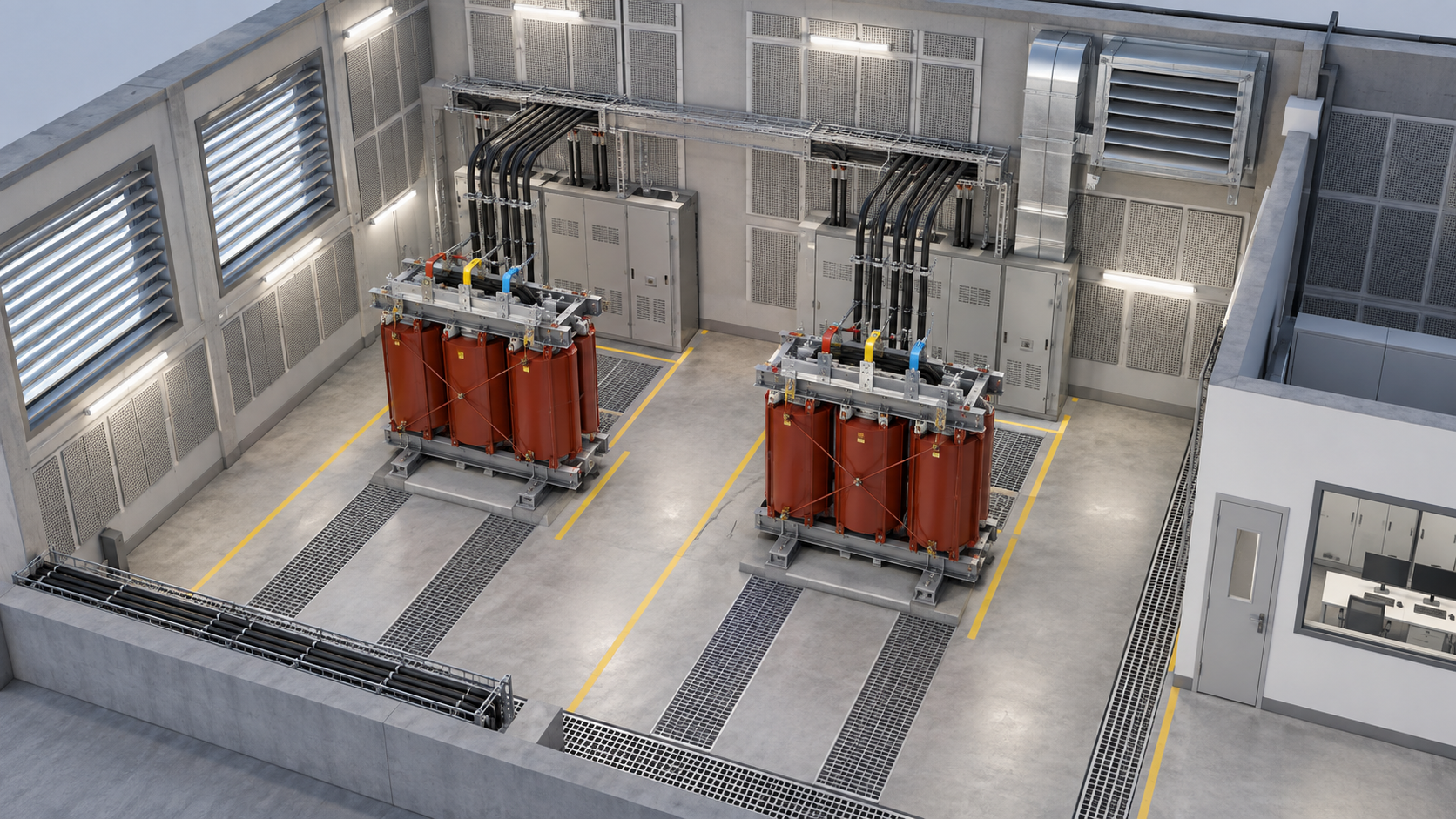
Consider an illustrative bid that states only “11 kV transformer, BIL 95 kV.” This is deliberately incomplete, not a recommended rating combination. The procurement reviewer should ask which terminal the 95 kV applies to, which standard governs the declaration and what evidence will accompany the supply. The engineer must then assess the requirement against the actual system.
Keep the equipment withstand review connected to the surge arrester interface assessment. An arrester is a protective device, while BIL describes equipment withstand. A higher insulation value alone does not prove that the installed protective arrangement is coordinated.
Before approval, retain the completed terminal schedule, the supplier’s deviations and the agreed test-document scope. Distinguish a design declaration from a report for the purchased unit. Do not label a catalogue table as the unit’s FAT result.
For a dry-type application, use the 100 kVA dry-type transformer page as an enquiry starting point. Send Zisheng Electric the system voltages, earthing arrangement, utility insulation requirements and required standards so the quotation can state a traceable insulation basis.
Technical references: Hammond BIL definition, IEEE lightning impulse terminology, and IEC 60076-3 consolidated scope.
High-altitude transformer specification for EPC projects: coordinate site elevation, insulation coordination, external clearances, ambient limits, cooling guarantees and FAT records before design freeze.
View details
Understand transformer no-load current, why it differs from no-load loss and inrush, and how EPC buyers can compare factory and field results correctly.
View details
Review a dry-type transformer fan upgrade before ordering: confirm the approved rating, electrical capacity, room ventilation, failure response and handover evidence.
View details
Compare VPI and VPE transformer offers by resin, processing, environmental duty and guaranteed performance. Learn which supplier evidence makes an EPC comparison useful.
View details